Visions of Government in 2040: Perspectives on the Future -- A Report from Mars
Published 15 November 2018

In the IBM Center’s new book, Government For The Future: Reflection and Vision for Tomorrow’ Leaders, part two of the book looks twenty years ahead offering perspectives on the future. This contribution is the first in a five-part series beginning with a dispatch from the Mars Exploration Base, Stardate July 20, 2039, authored by W. Henry Lambright.
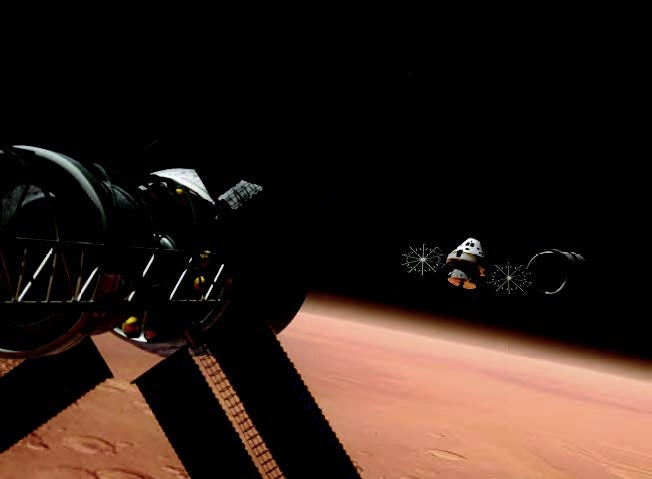
We have landed on Mars and have established our Mars exploration base. We landed today, the 70th anniversary of the Apollo 11 Moon landing by the U.S. in 1969. Let us tell you how we got to Mars and how the Mars 2039 mission differed dramatically from the way the U.S. reached the Moon in 1969.
Our Mars Together Project, as it is called, involves space agencies from the U.S., Russia, China, Canada, Europe, Japan, Korea, India, and other nations. It is undergirded by hundreds of private sector and university partners, comprising thousands of scientific researchers from all over the world. The private sector partners are not only involved as contractors, but share in the costs of the project.
A collaborative governance model was used to get us to Mars and to effectively deploy the expertise that was assembled for our Mars mission. The Mars Together Project is a strong contrast to the NASA-dominant Apollo model. Our Mars mission is a logical extension of collaborative programs that began with the International Space Station (ISS) and were succeeded in the late 2020’s and 2030’s by a global project to build a base on the Moon.
Along the way, government and private sector companies found incentives to cooperate to explore the universe. Public interest in Mars was stimulated by unmanned soil-sample returns to Earth indicating strongly that Mars once had or still had life. In the past decade, the 2030s, human spaceflight and robotic technology merged in the interest of exploration.
The path to Mars can be traced over three critical phases described below. Each phase outlines the key building blocks -- successes and failures -- that made this collaborative effort possible.
First Steps on the Road to Mars (1969 to 2018)
What did it take to get to Mars? What made collaboration among nations, and between nations and the private sector, successful? The past was our guide to the present, 2039, and the past showed us examples of false starts, mixed results, and successes.
False Starts
Mixed Results
Successes
Becoming More Collaborative (2018-2030)
Following planning, in 2022 a group of nations and private sector companies agreed to create the Mars Together Project with a 2039 landing goal. Crucial to the success of this effort were key decisions on who does what, how, why, and when. The participants assumed (correctly) that NASA and other partners would accompany flight missions to the Moon and Mars with rigorous research and development to create new technologies to speed transport, bring down costs, and increase safety. For example, in-space propulsion technologies, were necessary, along with technologies enabling human stays on the Moon and Mars.
Policy shifts were made in the 2020s. The U.S. ended its role on the International Space Station and diverted funds to the Moon and beyond. During this decade, NASA relinquished its leadership in low-Earth orbital flights, and begin to move more aggressively toward the Moon and Mars in preparation for the 2030s.
Due to its age, the International Space Station mission ended in the late 2020s. Starting in the 2020s, newer, smaller space stations were launched and run by the private sector and other nations.
The U.S. and NASA, in partnership with other nations and the private sector, began a robotic presence on and around the Moon in the late 2020s. The U.S. and China, previously rivals, furthered mutual exploration goals as partners throughout the late 2020s and early 2030s.
Exploring the Moon in Preparation for Our Trip to Mars (2030-2039)
During the decade of the 2020s, NASA and its partners built a small space station to go around the Moon as a step between the International Space Station and a Moon base. This outpost continued the International Space Station’s function of studying how humans adapted to journeys away from Earth. The lunar outpost was 250,000 miles away, in contrast to the ISS’s 250 miles, and astronaut stays exceeded one year. We were breaking the umbilical cord to Earth.
Our next step toward Mars, in the early 2030s, was to land and operate on the lunar surface. Given its minimal gravity, the Moon served as an ideal point of embarkation to Mars for humans and supplies. As with the International Space Station, NASA needed to pioneer, develop, and avoid becoming an “operating” organization on the Moon. The Red Planet was our goal.With the Mars Together Project in place in the early 2030s, full attention was given to landing on Mars.
Success Factors in our Trip to Mars
The Mars Together Project, declared in 2022, has reached its goal of landing on Mars. What critical factors brought our mission to its successful landing on Mars?
The success factors discussed above took the Mars Together Project from a concept to a launch to the Martian surface. The project required nations, government agencies, and private sector companies to think big and “outside the box” about ends and means.