





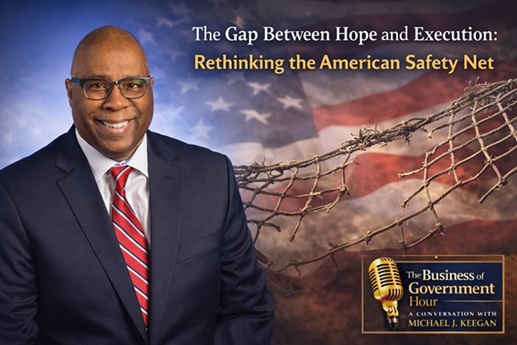
The Gap Between Hope and Execution: Rethinking the American Safety Net
Submitted by MKeegan on Thu, 04/16/2026 - 10:27
Thursday, April 16, 2026
Clarence Carter has spent 34 years watching the same heartbreak repeat itself. A family in crisis walks through the door of a government office. They need help: real, sustained, life-changing help. What they get instead is a form. Then another form. Then a phone number. Then another office. By the time the system has finished processing them, the moment of intervention has often passed.
Carter is Commissioner of the Tennessee Department of Human Services, author of Our Net Has Holes in It, and a veteran of federal, state, and municipal service spanning two presidential administrations, four governorships, and a mayoral office. That breadth alone is notable. What distinguishes him, though, isn’t the résumé — it’s the argument: that America’s safety net fails not because the country lacks the will or the resources to help people in need, but because the system delivering that help is, in his own plainspoken word, “stupid.”
He explained this to me recently on The Business of Government Hour, and he said it without apology not because he thinks Americans don’t care, but quite the opposite. He opened our conversation by describing a society that would, as he put it, “metaphorically give one the shirt off its back.” The first chapter of his book marshals the evidence: mandatory federal spending on social welfare programs ran close to $3.8 trillion in fiscal year 2024. The problem Carter is diagnosing isn’t indifference. It’s a profound and costly gap between intention and execution.
“What compelled me to write it,” he told me, “is the distance between our hope as a society and our execution in this space.” The failures of the safety net, he contends, are “not that we don’t care enough, not that we don’t fund enough, not that we don’t have enough programs.” The failure is structural — a failure of design.
One Night at the Circus
Carter traces his entire career in public service back to a single childhood evening at the circus, watching high-wire performers work impossibly far above the arena floor. When he asked his mother what would happen if one of them fell, she pointed lower and explained that the safety net below would catch them. Almost on cue, one of the performers did fall — bounced into the net, climbed back up, resumed the act. “Little did I realize at eight years old,” Carter reflected, “that I had seen a glimpse into my future.”
The book’s animating question flows naturally from that memory: what happens when the net has holes that won’t break the fall?
Three Holes in the Net
Carter spent much of our conversation cataloguing those holes, and he’s precise about what they are.
The first is the absence of any shared vision for what the safety net is actually supposed to accomplish. His central metaphor in the book is the Winchester Mystery House: that sprawling, architecturally incoherent California mansion built over decades without a plan, filled with staircases that run into ceilings and hallways that lead nowhere. America’s system of public supports, he argues, was assembled the same way. “There was no intentional design.” Generations of political moments gave rise to more than 100 federal programs, each addressing a singular aspect of the human condition, with no mechanism to connect them or make the whole greater than the sum of its parts.
The second hole follows directly from the first. Because there’s no unifying vision, the system is program-centric rather than person-centric. Carter has watched this dynamic play out across decades of frontline work. People who need public support rarely need just one thing. “They have multiple connected challenges,” he observed, “but yet the program set doesn’t realize that, and it is very difficult, if not impossible, to link programs together to take a more comprehensive view of service to that individual.” A vulnerable person must navigate a labyrinth of disconnected programs, often presenting the same information repeatedly to different offices. Before Tennessee consolidated its fragmented access points into a single digital portal, the department had 18 different phone numbers a consumer had to understand and navigate. “What an inefficient dishonoring of our consumer,” Carter said.
The third hole may be the most consequential. The system is held accountable for processes, not for wellbeing. I pressed Carter on this directly, asking about the chapter in his book titled “What Exactly Is Wrong?” His \answer was illuminating. Running the SNAP program in Tennessee, he’s measured on three things: did the right person receive the benefit, in the right amount, within the appropriate timeframe? “If I do those three things well, I have run an excellent food stamp program.” But that framing, he argues, asks entirely the wrong question. “If our vision is to be this notion of growing capacity to reduce dependency, shouldn’t we also measure what did we do to help that individual or that family not need food stamps maybe next week, next month, next year?” The success he actually wants to celebrate is the day a recipient can look at the system and say, as he put it, “thanks, but no thanks” — not because the support wasn’t valuable, but because they no longer need it.
Growing Capacity, Reducing Dependency
That phrase — growing capacity to reduce dependency— is the North Star of Carter’s reform philosophy, and it runs through everything Tennessee has been building under his leadership. The department is a $3 billion operation serving nearly two million Tennesseans across 95 counties and 17 programs.
Within that footprint, Carter has been working to shift the underlying logic not just to administer programs efficiently but to build something that actually moves people toward self-sufficiency.
His approach to partnership is one of the more interesting features of his model, because it requires government to fundamentally reframe its own role. Carter’s blunt about what government can and can’t do. “Government is decent to good at transaction,” he told me. “What government wasn’t designed to do and cannot do is relationship.” If building capacity in vulnerable individuals requires both transactional support and genuine human connection, then government alone is structurally insufficient for the job. His response has been to actively recruit faith communities, private businesses, and civic organizations as structural partners — not supplemental helpers. Carter offered his own inversion of Reagan’s famous quip: “We want to say, we are from the government and we are here asking for your help.”
In Tennessee, that posture led to direct outreach to the state’s Office of Faith and Community, created under Governor Bill Lee with an explicit cross-sector mission. Carter went to the director and said simply: “Lance, I’m asking for help.” The pitch was disarmingly honest. Government can deliver transactions, faith communities foster relationship, and people in vulnerable circumstances need both. The response was enthusiastic, and the work of aligning those two worlds has been ongoing ever since.
Engaging the Private Sector Differently
Carter applies the same logic to business. Government too often approaches companies as donors or corporate citizens. Business, he’s quick to point out, is in the business of business. It has a bottom line to meet. The more productive question isn’t how to appeal to corporate generosity, but how human services can actually help businesses succeed.
The answer, in his view, lies in workforce development. Tennessee, like many states, faces a paradox: robust economic growth alongside vast untapped labor. Carter noted that over 400,000 working-age Tennesseans are neither employed nor in school — a figure that isn’t just a social challenge but an economic one. His strategy is to align human services directly with labor market needs, transforming program recipients into active contributors. “We shouldn’t approach business from a charity perspective,” he said. That reframe — human services as an economic engine rather than a social expenditure — changes the entire conversation.
Putting the Theory to the Test
One of the more underappreciated themes in our conversation was the need for space to think, test, and redesign. “We are so immersed in the doing,” Carter admitted, “that sometimes there isn’t much opportunity to actually think and grow.” It’s a candid acknowledgment that even well-run government agencies can become prisoners of their own operational tempo.
The Tennessee Families First Community Advisory Board, which Carter chairs, represents one of the more ambitious experiments in this direction. It grew out of a fiscal anomaly: the state had amassed nearly $740 million in unexpended TANF block grant funds — the largest such reserve in the country. Carter worked with Governor Lee and the legislature to channel that capital into the Tennessee Opportunity Act, which authorized seven pilot initiatives testing different models of capacity-building within families with dependent children. Those pilots are now nearing the end of their evaluation phase. Carter is careful about previewing findings but reports that each of the seven models has shown “appreciable movement” toward growing capacity and reducing dependency.
The broader lesson isn’t hard to draw: real transformation requires not just the capacity to execute, but the discipline to experiment and the humility to learn.
On Technology: Design First, Tools Second
Technology plays a central role in this transformation, but Carter is clear-eyed about its limits. During his federal tenure, he walked a group of technologists through the architecture of the system and their response stopped him cold. They told him he didn’t need new technology. He needed new business processes. That exchange captures something important about the limits of most government modernization efforts: technology can streamline what exists, but it won’t rescue a system that was never well-designed to begin with.
That said, Carter sees genuine potential in AI just not in the way it’s usually framed. “The vast majority of people come into this work with a desire to help people,” he observed, “but the system makes them administrative clerks.”
If AI can absorb the administrative load — the forms, the processing, the routine decisions — it returns something that’s harder to manufacture: time, attention, the capacity to actually engage with the person sitting across the desk. In many cases, that’s where the real work happens.
A Long Road, A Clear Purpose
Debates about the safety net tend to collapse into familiar territory — more funding or less, more programs or fewer. Carter’s argument cuts across that. He’s not calling for more or less.
He’s calling for better alignment: between intention and execution, between programs and people, between what we measure and what actually matters.
His message, at bottom, is an optimistic one. The gap between what the safety net promises and what it delivers isn’t inevitable. It’s the product of choices made about design, priorities, and what questions we’re willing to ask, which means it can be changed by making different choices. That’s the work Carter has taken on, through his leadership in Tennessee, through his writing, and through the broader conversation he’s pushing the field to have. The safety net, he argues, was never fully designed to begin with. The challenge before us isn’t simply to patch it. It’s to finally build it — deliberately, purposefully, with the people it serves in mind.
Download the audio file.