





NEW SPECIAL REPORT: Five Pillars of Effective Government: A Framework for Governing in an Age of Complexity
Submitted by MKeegan on Wed, 01/14/2026 - 12:36
Wednesday, January 14, 2026
Report co-authors Margie Graves and Michael J. Keegan
Government today stands at a crossroads.Global change continues to accelerate—through disruptive technologies, increasingly complex cross-national risks, rapid shifts in economic and social conditions, and rising public expectations for fast, trustworthy, and high-quality services. Every day, public agencies must manage challenges that no organization—public or private—can navigate alone, including protecting critical infrastructure from cyberattacks, responding to natural disasters, delivering benefits during emergencies, building resilient communities, and ensuring that essential services reach the public fairly and reliably.
The IBM Center for The Business of Government has spent more than two decades informing leaders about effective practices for meeting these challenges, by grounding public-sector innovation in evidence, research, and real-world experience.
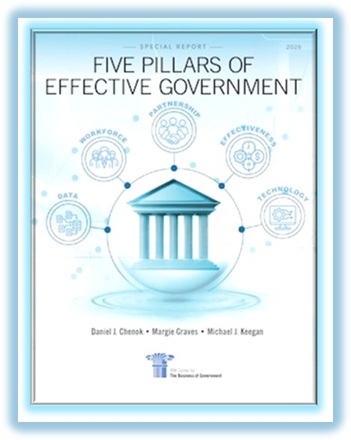
Today, we are pleased to announce the release of a groundbreaking special report, Five Pillars of Effective Government, which continues advancing this work by identifying five areas where meaningful progress can have the greatest impact—areas where the right ideas, the right tools, and the right leadership can strengthen the capacity of government to serve the nation.
This report is built around five central pillars:
- Multi-sector partnerships
- Financial and operational effectiveness
- Technology-enabled service and efficiency
- Data-driven decision-making
- A strong and modern government workforce
Individually, each pillar addresses a fundamental dimension of good governance. Together, they support a comprehensive strategic framework for delivering on what the public expects—and deserves—from its institutions: a government that works, responds, and earns trust through performance.
What the Five Pillars Reveal
- Partnerships Are Now Essential, Not Optional
No single organization can solve the hardest problems alone. Whether delivering vaccines, planning for climate risks, strengthening supply chains, or modernizing digital services, success increasingly depends on partnerships—across agencies, across levels of government, and across sectors.
The report shows how well-designed partnerships:
- Tap the innovation and agility of the private sector.
- Integrate the reach and expertise of nonprofits and universities.
- Align federal, state, and local efforts toward shared goals.
- Create “whole-of-government” approaches capable of tackling issues that cut across boundaries.
When partnerships build on trust, shared data, and mutual accountability, government’s impact expands dramatically.
- Fiscal and Operational Stewardship Matter More Than Ever
The public expects government to invest resources wisely and deliver value.Yet agencies face enormous pressures: rising costs, aging systems, administrative burdens, and the constant need to do more with less.
This pillar highlights practical ways to improve performance—such as:
- Modernizing financial management
- Using analytics to anticipate future needs
- Designing operations around user needs
- Preventing fraud and improper payments before they happen
- Modernizing procurement to speed results and strengthen accountability
Financial responsibility and operational excellence reinforce one another.When government operates effectively, public trust grows.
- Technology Is Transforming Government’s Mission
Technology continues to reshape how government works.From artificial intelligence to cloud computing to digital identity systems, emerging technologies offer extraordinary opportunities to improve services, strengthen cybersecurity, and support public employees.
This pillar shows how technology enhances:
- Emergency preparedness and disaster response
- Benefits delivery, including during crises
- Protection of sensitive government data
- User experience for everyday services
- Operational efficiency through automation and AI-enabled decision support
But this pillar also emphasizes a critical insight: technology succeeds only when used thoughtfully, ethically, and with people—citizens and public servants—placed at the center.
- Data Has Become the Foundation of Effective Governance
Sound decisions depend on quality and timely data.Government agencies now generate and manage enormous amounts of information, and when used effectively, data can transform policymaking, program management and evaluation, and public engagement.
This pillar explains how:
- High-quality, well-governed data improves priority-setting
- Evidence and evaluation strengthen accountability
- Cross-agency data sharing enables a more complete picture of public problems
- Modern analytics—including machine learning—help leaders see what is coming before it arrives
Data-driven government gives public leaders the insight they need to make choices that improve real lives.
- A Strong Workforce Is the Backbone of Government
Every public service—from emergency response to benefits processing—is ultimately delivered by people.Yet the government workforce faces increasing strain: retirements are rising, hiring is slow and complex, skills gaps are widening, and employee engagement has been shaken by years of disruption.
This pillar outlines a path forward by:
- Modernizing hiring to bring in talent quickly and fairly
- Updating compensation systems to reward performance and attract new skills
- Expanding training and upskilling so the workforce can take full advantage of new technologies
- Strengthening accountability systems that support excellence
- Developing leaders who can guide agencies through uncertainty and innovation
In short, better government depends on better supporting the people who make it work.
A Strategic Framework for Integration
While each pillar offers valuable insights individually, the report's greatest contribution may lie in how it demonstrates their interconnections. Multi-sector partnerships depend on data-sharing infrastructure and workforce capabilities. Financial effectiveness requires both technological tools and skilled analysts. Technology implementation succeeds only when supported by appropriate training, change management, and performance measurement. Data-driven decision-making enables leaders to identify partnership opportunities and optimize resource allocation. And workforce development ensures that agencies can leverage all other capabilities to maximum effect.
This integrated perspective reflects the report's underlying philosophy: government transformation requires comprehensive strategies that address people, processes, technology, and governance simultaneously. Isolated reforms, no matter how well-designed, cannot overcome systemic barriers or deliver sustained improvement. Only by pursuing coordinated action across all five pillars can agencies build the comprehensive capabilities required for 21st-century governance.
A Call to Leadership
Ultimately, Five Pillars of Effective Government represents both a comprehensive analysis and an urgent call to action for public sector leaders. The report makes clear that the challenges facing government are substantial, but they are not insurmountable. With the right strategic frameworks, evidence-based approaches, sustained commitment, and leadership vision, agencies can transform their operations to deliver better outcomes at lower costs while strengthening public trust.
The authors—each bringing extensive government and consulting experience alongside deep expertise in technology, data, management, and leadership—offer a hopeful message: government can deliver exceptional value to the public when equipped with appropriate tools, practices, and capabilities. The path forward requires dedication, investment, and patience, but the destination—a more effective, responsive, and trusted public sector—is within reach.
Conclusion
As government leaders navigate an increasingly complex landscape, Five Pillars of Effective Government provides an invaluable resource for charting the course forward. Whether you are a senior executive seeking to drive organizational transformation, a program manager working to improve operations, a technology leader implementing modernization initiatives, a data professional building analytics capability, or a human capital specialist strengthening workforce capacity, this report offers insights, frameworks, and practical guidance to inform your efforts.
The IBM Center for The Business of Government invites government executives, practitioners, researchers, policymakers, and all those committed to public sector excellence to engage with this framework, adapt its insights to their own contexts, and join in building a government worthy of the challenges ahead and the citizens it serves.