





Beyond the Crisis: Leadership Lessons from Dave Lebryk
Submitted by MKeegan on Thu, 12/11/2025 - 00:00
Friday, December 12, 2025
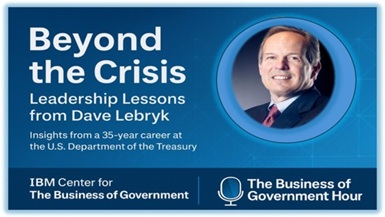
During his 35-year career at the U.S. Department of the Treasury, Dave Lebryk rose from a Presidential Management Intern to become the Fiscal Assistant Secretary, overseeing some of the most critical financial operations in the federal government. His journey through six administrations and twelve secretaries offers profound insights into leadership, innovation, and the art of managing mission-critical systems that serve as the foundation of America's economy. I recently welcomed Dave back to The Business of Government Hour where he reflected on the lessons learned, the challenges overcome, and the principles that guided his success in transforming how government delivers financial services to the American people.
The Foundation of Public Service Leadership
Lebryk's commitment to public service was forged in his early experiences growing up in Valparaiso, Indiana, a small town devastated by steel mill closures that left unemployment hovering around 20-30 percent. He witnessed firsthand the vital role government can play in people's lives.
"Government can't do everything, nor should it do everything," he reflected. "But government can really be a great help for people. And I was one of the beneficiaries of that."
This personal connection to government's mission shaped his entire career trajectory. As a full financial aid student at Harvard who worked "100 jobs," Lebryk learned what it meant to work without benefits and in positions vulnerable to economic changes. These formative experiences instilled in him a fundamental belief in how government should serve people better—a commitment that sustained him through decades of public service.
Understanding the Civil Servant's Role
One of Lebryk's most critical leadership insights centers on understanding the distinct role of career civil servants versus political appointees. Early in his tenure at Treasury, he established a clear approach that would guide his interactions with leadership throughout his career.
"The role of civil servant in most cases with their relationship with the political appointees who come in is to be an advisor," he explained. "And one of the things I think you have to understand is you're not a decision maker."
This clarity proved essential when working with Frank Newman, who came to Treasury from Bankers Trust with little government experience. Lebryk approached Newman at the outset, offering to facilitate his transition while making clear he understood if Newman wanted to bring in his own person. Newman kept Lebryk on for two and a half years, while ascending from Under Secretary to Deputy Secretary and then Acting Secretary. The partnership flourished because Lebryk focused on explaining the organization clearly, helping Newman navigate unfamiliar territory, and allowing him to concentrate on decision-making. During Newman's tenure, five pieces of domestic finance legislation were enacted—a testament to focused leadership.
The Three Pillars of Organizational Excellence
As Lebryk moved from advisor to decision-maker, eventually leading the Bureau of the Fiscal Service, he developed a framework for organizational leadership built on three essential components: strategic direction, operational excellence, and people management.
Strategic direction requires leaders to step back from daily operations and think long-term about organizational mission and priorities. In 2018, Lebryk created a 10-year vision for federal financial management, a luxury rarely afforded to political appointees with limited tenure. "When you have the turnover you have on the political level, you don't really get much of a time to sort of step back and say strategically where we're trying to go over the course of the next 5 or 10 years," he noted.
Operational excellencedemands unwavering focus on delivering core services. In Lebryk's world, this meant ensuring 70 to 75 million benefit payments reached Americans every month and conducting auctions to finance not just the U.S. government but the building blocks of the world economy. The commitment was absolute. He recalled a director in Kansas City who "would get on a horse if he had to deliver" those monthly payments on schedule. When that director retired, his successor would have done the same—a testament to the mission-driven culture Lebryk cultivated.
However, Lebryk recognized that operational excellence can create "silos of excellence"—teams so focused on their specific mission that they resist integration and innovation. Organizations end up with systems held together with metaphorical duct tape, building new requirements atop aging infrastructure without smooth integration. The challenge for leaders is maintaining daily operational excellence while simultaneously pushing toward innovation and modernization.
The third pillar—people management—encompasses attracting, retaining, developing, rewarding, and communicating with talent.
Lebryk's formula was elegantly simple: "Competence and character equal trust."
When people perceive their leaders as both capable and principled, they willingly go beyond requirements. During the pandemic economic impact payments, the Kansas City staff voluntarily worked seven days a week in multiple shifts, even on holidays, to ensure Americans received financial relief quickly.
"You do that because people believe in the mission, they trust their leadership and they're really good at what they do," Lebryk observed.
The Economic Impact Payments: Leadership Under Pressure
Perhaps no initiative better illustrates Lebryk's leadership under extraordinary circumstances than the pandemic economic impact payments. When Secretary Mnuchin announced that Lebryk would be responsible for delivering these payments within ten days, Lebryk's first thought was disbelief. The assignment seemed impossible—the last time Treasury had undertaken similar payments, it took five weeks just to issue the first payment.
Yet within ten days, the team issued the first 80 million payments. Within four weeks, 163 million payments had been delivered. Ultimately, Treasury would distribute 480 million economic impact payments throughout the pandemic. The scale and speed were unprecedented in government operations.
"The majority of the people who receive that payment didn't have to do anything," Lebryk marveled. "It just showed up in either in your mailbox or your bank account. That is a remarkable accomplishment."
The success hinged on partnerships—immediately collaborating with the Assistant Secretary for Tax Policy and working closely with the IRS and Bureau of Fiscal Service. It also required mobilizing trusted vendor relationships. When Treasury needed 30 million debit cards amid a global shortage, their vendor delivered because of relationships Lebryk had carefully cultivated over years. "That wasn't part of the contract," he explained. "It was because we had this relationship [honed over many years] that they would go the extra mile."
The experience reinforced Lebryk's belief that "government is really good in a crisis." When challenged to think beyond traditional silos and form cross-cutting teams, the federal workforce demonstrates remarkable ingenuity and innovation.
The tragedy, in Lebryk's view, is that this capability remains largely untapped during normal operations.
The DATA Act: Modernizing Through Agile Methodology
The Digital Accountability and Transparency Act (DATA Act) represented another watershed moment in Lebryk's career—this time demonstrating how government could modernize effectively when it embraced new approaches. The legislation gave authority to the Secretary of the Treasury and OMB Director to implement the first open data law in U.S. history, and the Secretary promptly assigned the responsibility to Lebryk.
The initiative faced skepticism from the outset, primarily because it came with no dedicated funding. Yet the CFO community across government stepped up.
"The CFO Community in the federal government is vastly underappreciated," Lebryk noted. "Yes, we were asking the CFO's to do things that were not easy. They all stepped up."
What set the DATA Act implementation apart was methodology. Previously, Lebryk and his team had built a data collection system using traditional approaches—developing functional requirements in isolation, building the system, and going live. The result was disastrous. The Deputy Director of OMB called with an angry complaint about how confused agencies were and how poorly implementation had gone.
For the DATA Act, they employed agile methodology—using sandboxes, testing immediately with agencies, engaging stakeholders at every step. When they went live, it was a "non-event." They accomplished in nine months what the old approach had taken years to deliver, at a fraction of the cost and with dramatically higher quality.
Their mantra became "better data, better decisions, better government."
When implementation succeeded, the OMB Deputy Director called again—this time to thank Lebryk for a smooth implementation. The difference?
"We were using agile methodology," Lebryk explained. "We were testing immediately with the agencies we were engaging with the agencies we were working with the agencies every step along the way so that when we went live was uneventful."
Despite this success, Lebryk expressed frustration that other agencies didn't rush to learn from the DATA Act experience. Few agile projects followed across government. The lesson transcends specific technology choices: government must design systems with users, not for users, through continuous engagement and iterative development.
Building Trust Through the Horizontal and Vertical
Early in his career, Lebryk learned a deceptively simple but powerful model for navigating organizational success. During a Treasury reorganization project under Secretary Robert Rubin, a consultant drew two intersecting lines and explained that career success depends on managing both axes effectively.
The vertical axis extends upward to leadership and downward to the team one leads. Success requires aligning with leadership priorities while effectively managing and developing one's team. The horizontal axis encompasses external stakeholders—contractors, vendors, partners—and internal stakeholders like HR, public affairs, budget, and procurement offices.
"How well you do in managing on that horizontal and vertical will determine how successful your career is and a lot of that is really about alignment," Lebryk explained.
Crucially, credibility on the vertical often depends on what people on the horizontal say about you.
"If you're not a trustworthy, someone of integrity or capable, they're not going to say a lot of good things about you."
This model shaped how Lebryk approached vendor management. He spent considerable time personally engaging vendors up to the CEO level, not to micromanage but to build relationships before crises emerged. When challenges arose, or when unprecedented needs like 30 million debit cards materialized, these relationships paid dividends far beyond contractual obligations.
The Future of Government: Skills for Tomorrow's Leaders
As Lebryk transitioned to teaching at Harvard's Kennedy School of Government, he brought clear-eyed assessment of government's challenges and opportunities. A central question he poses to students: "Can government be run like a business?" His answer is nuanced.
Government's "total addressable market" is every eligible American—350 million people—without the private sector luxury of targeting profitable segments. Government must serve everyone equally under law.
However, government should absolutely adopt private sector approaches to technology and operational efficiency. "What the private sector is doing with technology, absolutely the public sector should be pursuing [same]," he argued. "We're ages apart, we're generations apart from each other right now on how we're looking at technology."
The critical gap lies in user experience design. The private sector designs systems with customers, observing users and translating needs into technology. In general, government lacks this skill set. "We don't have that mindset," Lebryk lamented. Future government leaders must bridge this gap—not necessarily building sophisticated systems internally, but possessing sufficient technical literacy to understand and manage vendors effectively.
Research shows that when government employs more engineers who can manage contractors building roads, costs decrease, quality improves, and delivery accelerates. Conversely, without internal expertise, "you have overruns, you have poor quality and you have a lot of dissatisfaction and a higher cost."
Character, Courage, and Commitment
Throughout his reflections, Lebryk returned repeatedly to character as leadership's cornerstone. When advising political appointees on new initiatives, he would methodically work through four questions:
Do I understand the policy objective? Is it legal? Do I have capability to execute? What are the reputational risks?
This framework acknowledged that political appointees are decision-makers while career civil servants are advisors. "You are the decision maker, but I'm going to lay out for you what are the consequences of what you're attempting to do," he explained. When risks were clearly articulated, appointees sometimes chose different courses—evidence of good governance through honest counsel.
Lebryk's advice to emerging leaders emphasizes four qualities:
- maintain a learning mindset,
- develop comfort with technology,
- demonstrate courage in making tough decisions, and
- maintain deep commitment to people.
These qualities transcend partisan divides and organizational contexts.
On trust in government, Lebryk offers measured optimism. Trust in all institutions has declined, and "government" is poorly defined in surveys. People may distrust "government" broadly while trusting their local mail carrier or Social Security office.
The correlation between positive service experiences and trust is strong, reinforcing the importance of user-centric design.
Most encouragingly, Lebryk points to the military's transformation from the 1970s, when it had among the lowest approval ratings, to today's trusted institution. "What they did between now and then was they focused hard on leadership," he noted. The military invested in training leaders to make moral and ethical decisions and understand their role in civil society. The next generation of public sector leaders needs similar preparation.
A Legacy of Service
When David Lebryk received Treasury's highest honor, the Alexander Hamilton Award, and the 2025 Service to America Medal, the recognition affirmed more than individual achievement. It validated a career-long commitment to character, integrity, and the belief that government can and must serve people effectively. For this "kid from Valparaiso, Indiana", the journey represented both personal fulfillment and proof of public service's enduring importance.
Lebryk's career offers vital lessons for an era of declining trust in government and growing operational complexity.
Success requires understanding distinct roles of career and political leaders, balancing strategic vision with operational excellence, building trust through competence and character, embracing new methodologies like agile development, and maintaining courage to innovate while protecting mission-critical operations.
Most fundamentally, Lebryk demonstrated that government can perform extraordinarily when led well. The 480 million economic impact payments, the DATA Act implementation, and the fraud prevention systems that grew from stopping $650 million to $7.2 billion in fraud—these weren't products of massive budget increases or revolutionary technology. They resulted from clear-eyed leadership, talented civil servants given proper direction and trust, strategic partnerships, and willingness to challenge conventions while maintaining operational integrity.
Lebryk’s career proves that when leadership emerges—grounded in character, informed by learning, comfortable with technology, and committed to people—government can achieve remarkable results.@