Making Agile Happen: Pre-Service - Part III
The Portfolio Track Approach
Published 03 November 2021

The Portfolio Track Approach
The next post in this series moves away from addressing agile competencies in the traditional masters’ program the subject of the prior post, and suggests the creation of a portfolio track approach for future programs that provide education on agility in government. Broadly speaking, five portfolio tracks would serve as the main set of offerings of new public affairs education. These tracks would share five attributes:
Portfolio Track A: Range
Designed for students who want the flexibility to explore various disciplines and functions without specializing in any particular course of study, similar to existing programs that offer a “generalist” approach to curricular development. This portfolio track can be tailored to align most directly and strongly with the agile governance competencies, further refining and developing agile competencies seeded during the Induction phase discussed in the prior blog. Experiential learning settings would include public investigations, government initiatives and strategic planning, and intergovernmental coalitions.
Portfolio Track B: Role
Designed for students who want to have a particular role or position after graduation. Courses and experiences would focus on the knowledge and skills needed to succeed in operational positions in the public service arena, such as program management, public finance, risk management, cyber security, human resources, and program evaluation. Learning settings include governmental offices, public/private partnerships, public administrative offices, budget and finance offices.
Portfolio Track C: Issue
Designed for students who want to work in a particular policy/issue area. This portfolio exposes students to knowledge and tools addressing specific policy issues/disciplines. Settings involve experiential learning directly connected to the issue area, such as an energy think tank, water authority, or housing non-profit.
Portfolio Track D: Exploration
Designed to be a “portable” portfolio that schools of public affairs can offer to graduate students seeking advance degrees in discipline-specific areas, and who would like to understand how policy works and the mechanisms and tools used to engage with players in this community. For example, this portfolio would include classes on policy development, political communication, or writing for impact, and could be tailored for various clusters of disciplines: physical scientists, natural scientists, medicine, arts, or architects.
Portfolio Track E: Pulse
Designed to be a “pulse” portfolio that addresses unique individual interests. This portfolio would include:
The graphic below presents the portfolio concept. The dotted lines represent learning connections across the portfolios.
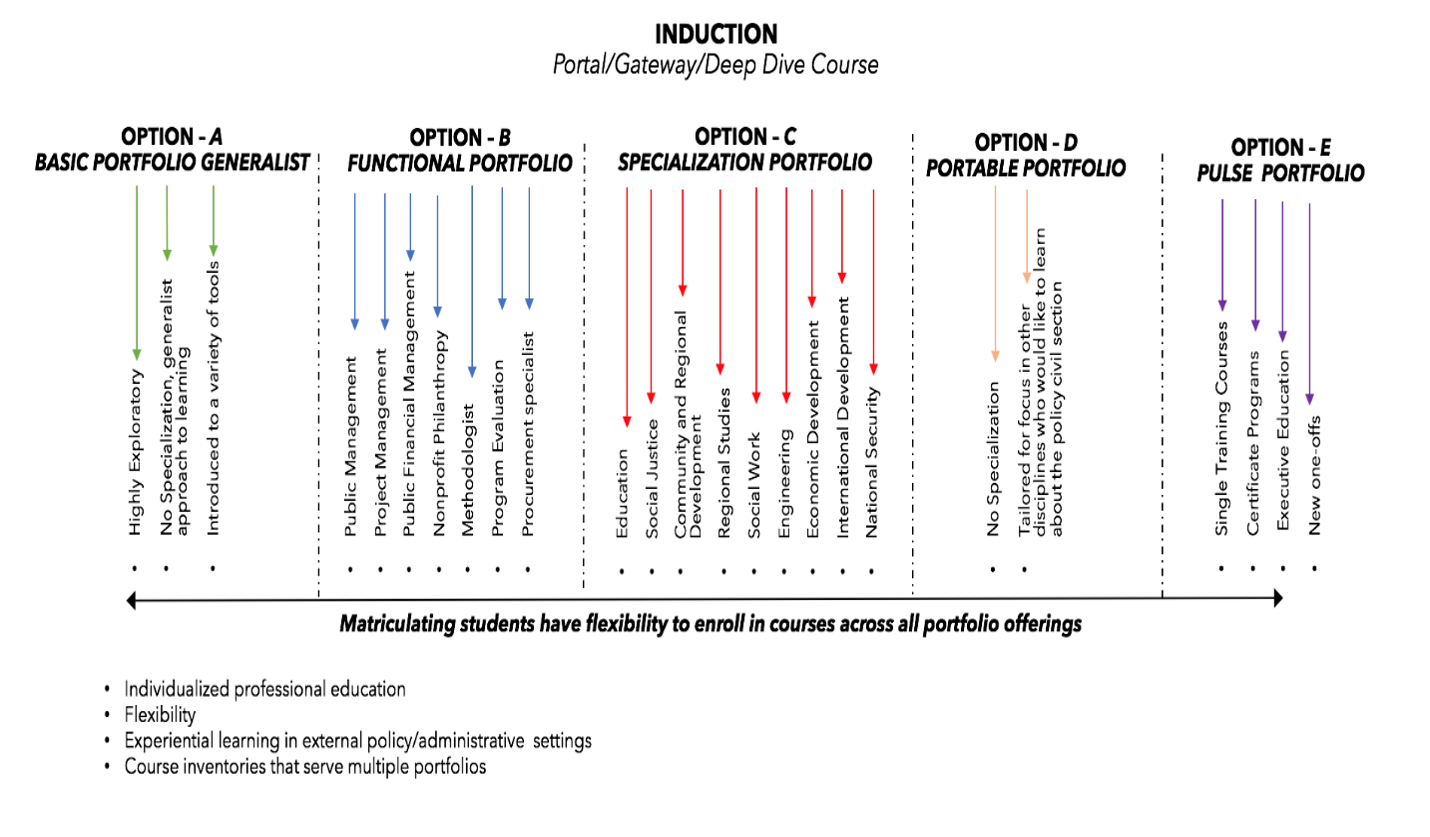
PORTFOLIO TRACKS: RANGE, ROLE, AND ISSUE
Matriculation for Portfolios A, B, and C
After successful completion of the Induction phase (discussed in the previous post, students would choose a particular portfolio in which to enroll. Students will take required foundational courses that develop competencies and build learning experiences aligned with the emphasis of the particular portfolio.
Portfolio Contents and Design:
Each of the A, B, and C portfolio tracks contains:
Matriculation for Portfolios D and E
These portfolio tracks are designed for those not ready to commit to professional graduate training in public affairs. The Tracks respond to either how public affairs impacts their work and profession (Portfolio D), or those not ready to commit full time to a graduate professional program but willing to take courses and earn credits that may be used in the future to enroll in a full-time program (Portfolio E).
Portfolio D: This portfolio would require the development of a basic course in public affairs offered to a wide range of audiences from students in other disciplines, community leaders, and members of the public. The course would include an understanding of public affairs settings, how policy is deliberated and administered, the data dimensions of policy, the role of intergovernmental governance, and citizen participation.
Portfolio E. This portfolio track can build upon extant programs that serve non-traditional masters students who cannot commit to full-time study. Program offerings in this portfolio can integrate agile governance competencies by designing specific content for each of these programs, or can allow those in this portfolio to enroll in courses offered in portfolios A, B, and C.
FINAL NOTE
Affecting changes discussed in this post will necessitate securing the interest and resources of a variety of players, including schools of public affairs, universities, foundations, associations, employers and potential enrollees. A commitment of this magnitude demands open minds and frank discussions. Those working on agile governance have built platforms, including the Agile Government Center within NAPA, upon which to have these discussions.
Next Post
As mentioned in this blog, the portfolio tracks foster participation from those currently engaged in the practice of public administration and policy. The next post will discuss ways that specific training on agile governance competencies can be offered to those in public service.
Links to all posts in this series: