Developing an AI Strategy within a Defense Intelligence Context
Insights from Ramesh Menon, Chief Technology Officer and Chief Artificial Intelligence Officer, Defense Intelligence Agency
Published 13 December 2024
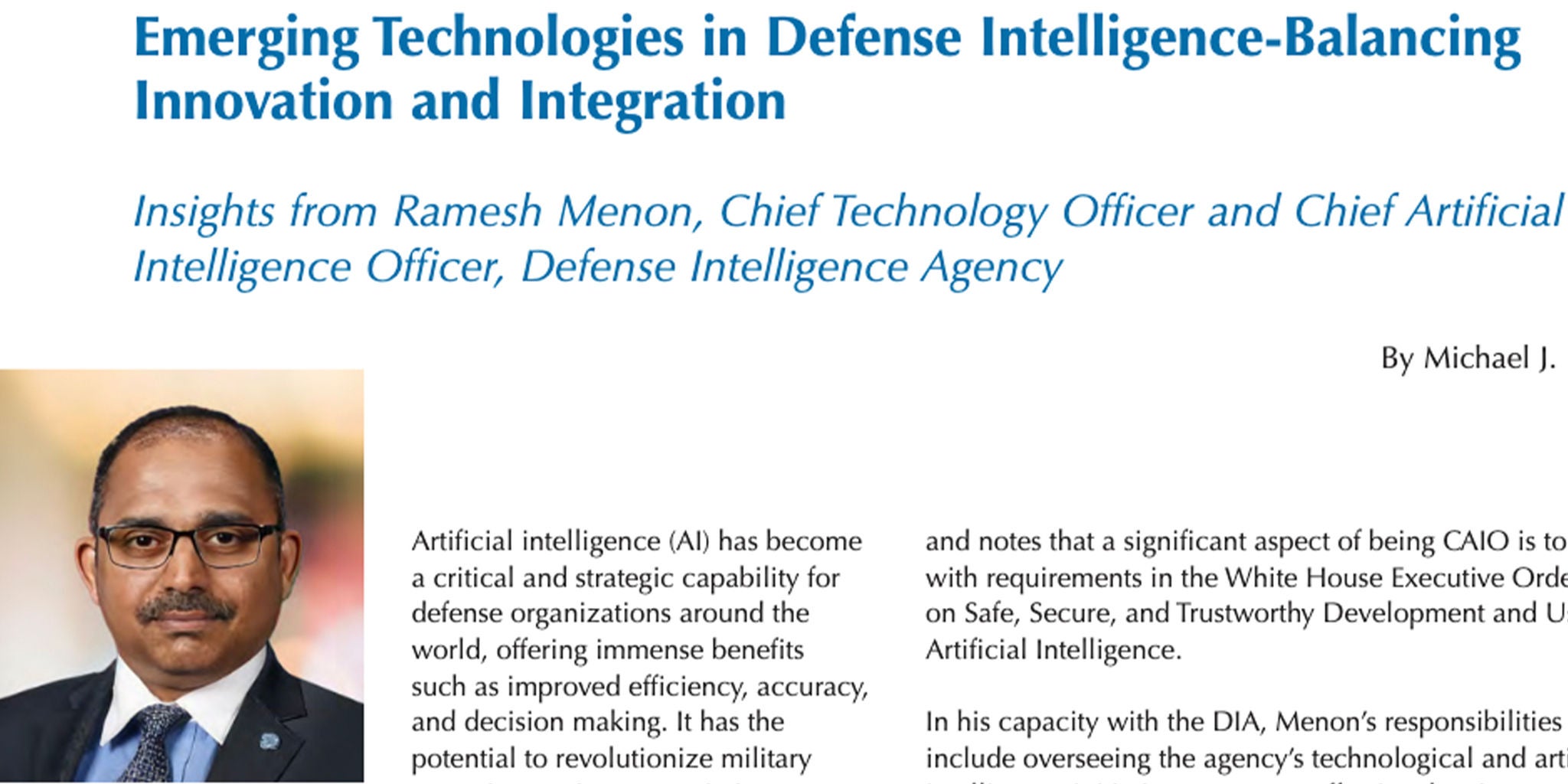
Insights from Ramesh Menon, Chief Technology Officer and Chief Artificial Intelligence Officer, Defense Intelligence Agency
Artificial intelligence (AI) has become a critical and strategic capability for defense organizations around the world, offering immense benefits such as improved efficiency, accuracy, and decision making. It has the potential to revolutionize military operations to improve mission outcomes and gain decision advantage.
Ramesh Menon, chief technology officer (CTO) and chief artificial intelligence officer (CAIO) at the U.S. Defense Intelligence Agency (DIA), joined me on The Business of Government Hour to discuss the agency’s AI strategy, the strategic implementation of AI, the challenges faced, and the evolving landscape of intelligence and national security. We explored how the DIA is harnessing AI to enhance its mission of providing military intelligence. The following is an edited excerpt of our discussion, complemented with updated and additional research.
As a combat support agency, DIA operates at the intersection of the U.S. Department of Defense (DoD) and the Intelligence Community (IC). Its primary mission is to deliver intelligence on foreign military capabilities to ensure U.S. national security. This involves a fusion of intelligence sources to provide actionable recommendations to top-level decision makers, including the secretary of defense, the Joint Chiefs of Staff, and combatant commands. Menon’s dual roles as CTO and CAIO span technology strategy, governance, and the implementation of AI in line with national security directives. He chairs the Technology Leadership Council for the agency and notes that a significant aspect of being CAIO is to comply with requirements in the White House Executive Order 14110 on Safe, Secure, and Trustworthy Development and Use of Artificial Intelligence.
In his capacity with the DIA, Menon’s responsibilities include overseeing the agency’s technological and artificial intelligence initiatives to ensure effective data integration, driving innovation, and maintaining security. He focuses on advancing digital platforms and algorithms to enhance intelligence processes, building governance frameworks for the safe and ethical use of AI, and developing an AI- ready workforce to lead the cultural and technological transformation at the DIA.
Menon outlines a multifaceted strategy to integrate AI within the DIA, emphasizing the need to bridge the gap between AI development and deployment. Key components of this strategy include:
He identifies two primary challenges in integrating AI into the DIA’s operations: cultural resistance and technological scalability.
Menon acknowledges that cultural transition becomes a lot easier if you have an AI-ready workforce. “Integrating into operations requires us to be more intentional; it is a deliberate activity.” says Menon. “The challenge is to take technology from a TRL 7 to TRL 9 and integrate it into operational environments.” Finding skilled AI professionals, such as principal AI security scientists, is not easy. There are caps on what can be done with current talent pools. During our conversation, Menon underscores the complex interplay of cultural readiness, operational integration, talent acquisition, and policy compliance as significant hurdles to effectively implementing AI.
Effective data management practices are essential for AI scaling. This includes handling large volumes of data efficiently and ensuring data quality and relevance. Strategic investment in AI infrastructure, including hardware and software, supports scaling efforts. This includes investing in scalable cloud solutions and other technologies that facilitate AI deployment. In summary, scaling AI involves a combination of operational integration, workforce adaptation, governance, collaboration, and strategic investment. Addressing these factors holistically ensures that AI technologies can be deployed effectively and scaled to meet organizational needs.
We explored the various opportunities and challenges Menon and his agency faces in its digital transformation and AI journey. Here’s a brief summary of some of what we discussed.
Menon observes that the landscape of intelligence and national security has evolved significantly, particularly with the rise of open-source intelligence and the proliferation of AI technologies. The Russian-Ukrainian conflict exemplifies the increasing importance of open-source intelligence in modern warfare. Additionally, the rapid development of generative AI models presents both opportunities and challenges. The financial and infrastructural demands of these technologies necessitate careful planning and collaboration with industry partners to ensure sustainable integration.
He advocates for strong industry-government partnerships, particularly through collaborative research and development, the transition of mature technologies, and openness to innovative proposals. He also stresses the importance of maintaining a balance between technological progress and ethical standards.
Menon acknowledges the gap between industry and government, noting that while the commercial sector moves quickly and focuses on sales and revenues, the government is mission driven. Bridging this gap requires large systems integrators who can translate commercial technologies into mission-specific applications. The rapid pace of AI development in the commercial sector, fueled by substantial venture investments, underscores the need for a strong technological and economic ecosystem to support national capabilities.
Effective leadership, according to Menon, hinges on three principles: listening, leading with courage and conviction, and maintaining humility. Listening to diverse perspectives within the organization helps in understanding the unique needs of different intelligence services and combatant commands. Leading with courage ensures that necessary but potentially uncomfortable changes are implemented. Humility can foster a more collaborative environment where all voices are heard and respected.
The DIA is committed to leveraging AI as a transformative technology. The future will see AI becoming increasingly integral to DIA operations, influencing various functions and advancing the agency’s capabilities. The strategy will evolve with AI continuing to drive innovation and improvement in intelligence processes. “The most important is talent and skills,” admits Menon. “If I have an AI-ready workforce, the cultural transition becomes a lot easier.” Developing an AI-ready workforce is a priority. The agency is focused on building skills and competencies in AI, which will facilitate smoother transitions and better adoption of new technologies within the organization. Collaboration with industry and academic partners is also key to advancing technology. The DIA will continue to leverage external expertise and create partnerships to drive innovation and integrate new solutions effectively.
Menon also emphasized the need for continuous improvement and adaptation to stay ahead of technological advancements. Organizations must be flexible and responsive to changes in technology trends and emerging challenges. From getting the right people to funding efforts, he acknowledges the importance of the strategic allocation of resources to address budget constraints. By optimizing the portfolio and making informed decisions about where to invest, organizations can balance core system maintenance with innovation. This approach helps manage financial limitations while supporting technological advancements.
Menon’s strategy for the future at the DIA involves a comprehensive approach to adopting and integrating advanced technologies, with a strong emphasis on governance, workforce development, and collaboration. The aim is to ensure that the DIA remains at the forefront of technological innovation while maintaining ethical standards and operational efficiency.
Our discussion describes the multifaceted nature of leveraging AI in defense intelligence, from technological integration to cultural transformation and strategic partnerships. The DIA’s strategic focus on data utilization, innovation, adaptive workforce, and partnerships, combined with its efforts to overcome cultural and technological challenges, underscores its commitment to maintaining a strategic intelligence advantage.