Government technology programs often follow a similar pattern. An agency announces a new platform, based on a modular strategy: flexible components, interchangeable parts, future-proof by design. Then, a few years into implementation, the new “modular” system has become, functionally, a monolith. The seams between components have calcified. Dependencies have multiplied. The promised flexibility waned.
Understanding the reasons for this pattern helps to explain digital change in government can stall.
MONOLITHIC SYSTEMS HAVE GROWN OVER TIME
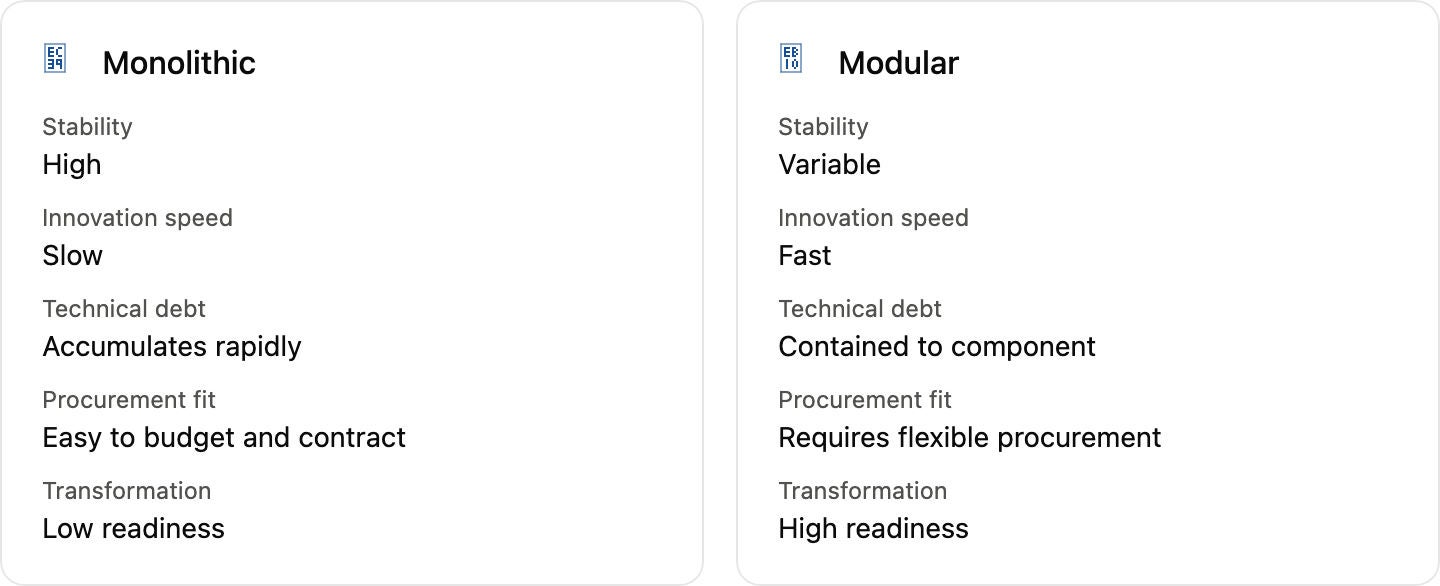
A monolithic system stems from a single unified structure -- all components tightly integrated, interdependent, and designed as a whole. This has genuine advantages. Monolithic systems bring stability, with most use cases anticipated before deployment. Maintenance is easier in the short term.
But these advantages also point to long-term liabilities. Changing part of a monolithic system often requires changing it in whole. As the system evolves, technical debt accumulates. The architecture that made deployment easy becomes the architecture that makes evolution expensive.
Monolithic architectures align closely with past efforts at digital modernization -- incremental improvements to maintain performance and reliability without altering core processes. Digital transformation requires the opposite: the capacity to reconfigure the “how” of work organization, citizen service, and value creation. A monolithic system inherently resists that kind of change.
WHAT MODULAR SYSTEMS PROMISE
Modular systems include discrete, interchangeable components that can be developed, tested, and maintained independently. In theory, this enables experimentation –innovating an isolated module without destabilizing the broader system.
This architectural logic fosters digital transformation. Transformation depends on the ability to recombine capabilities -- using modular architecture in ways that enable reassembling digital resources to create new value in new ways. This approach creates what researchers have called “generativity” -- the capacity to produce unexpected innovation at multiple layers in a system, simultaneously.
But modularity introduces more complexity for design and governance than monolithic architecture. Managing the interaction between modules requires deep upfront planning. As one government CIO has said, “Our technology aim is to get to a simpler modular world... but what we are actually finding is the opposite: the new platforms are just new monoliths. We are going to modular, but we are actually creating increasing amounts of complexity.” -- Government CIO, interviewed for the study
WHY GOOD INTENTIONS PRODUCE NEW MONOLITHS
Modular aspirations can fail in practice due to lengthy and process-laden budget and contracting processes.
Government budgeting tends to favor unified, coherent systems with clear scope and defined deliverables. Modular architectures, with distributed components and phased development, are harder to defend in budget review processes and pose a challenge in defining the scope of a single procurement.
As a result, agencies that intend to build modular systems often end up structuring their funding and acquisition strategies as a monolith. Modular intent is modular faces financial reality in a way that forces consolidation. By the time the system goes live, modular seams have disappeared.