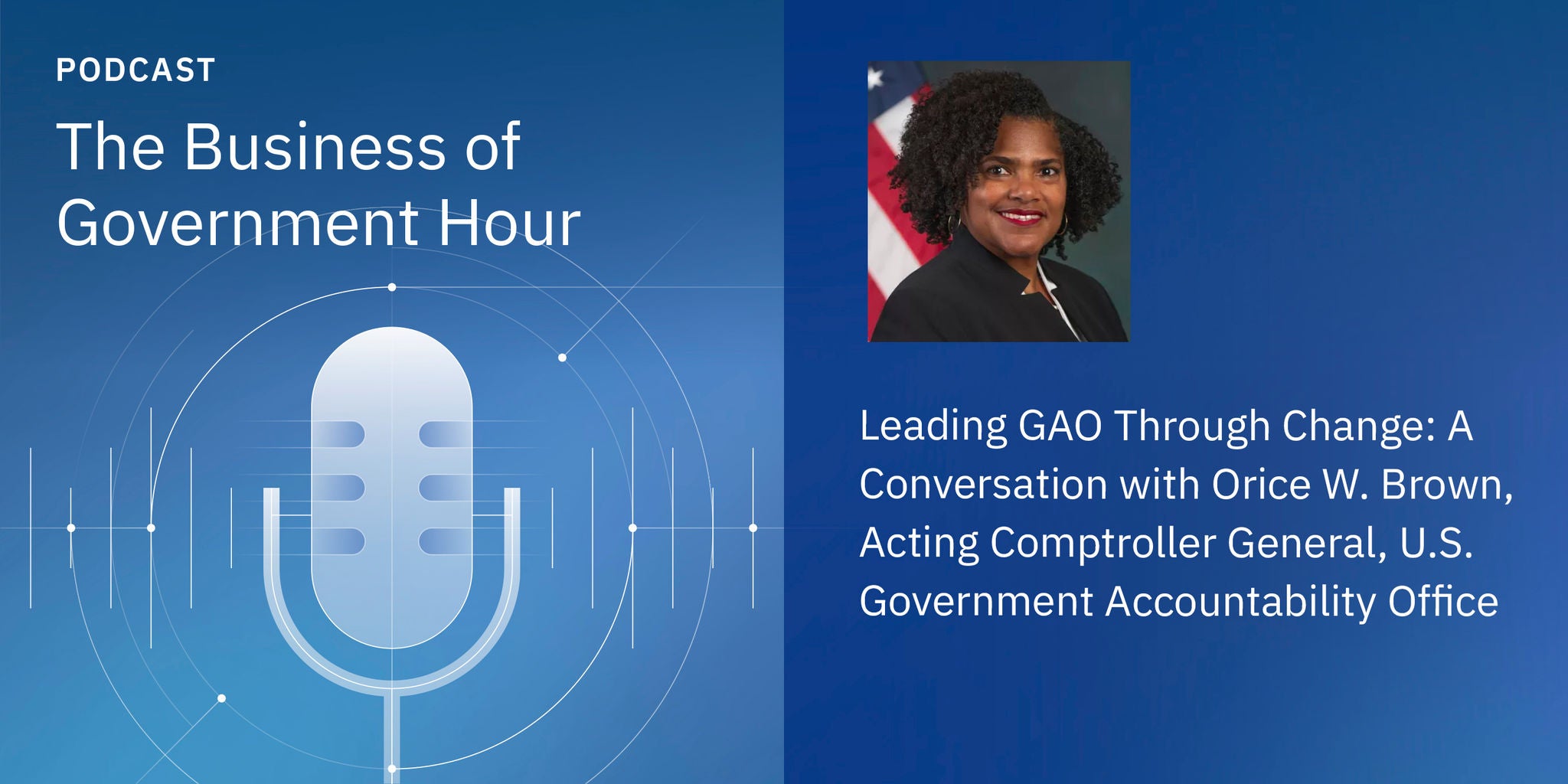
I spoke with her on The Business of Government Hour about what this period demands of GAO and of her as its leader. Her first answer set the tone for our conversation. “GAO can’t stand still,” she said. “I can’t stand still waiting for a permanent comptroller general to be confirmed. It requires that we as an organization and that I as the acting comptroller general really meet this moment.”
Her reasoning starts with GAO’s primary client. Congress keeps changing, and so do its needs. “Congress continues to need timely, fact-based, nonpartisan information from us, and we’re moving ahead with our efforts to evolve and modernize how we deliver that service to Congress,” she explained.
The following draws on our conversation to examine how GAO sets its priorities, detects systemic risk, crafts recommendations agencies will adopt, and prepares for its next chapter. Her answers return to one conviction. Oversight makes the greatest difference when problems are identified early, and agencies take action to correct them.
Leading GAO as One Institution
Brown describes the comptroller general’s role as having “three moving parts.” She must serve Congress, lead GAO, and act as the federal government’s chief accountability officer. “I have to make sure I deliver on all of those parts,” she said.
The third role includes issuing government auditing standards used by auditors across the country. “GAO has reinvented itself several times over its 100-plus-year history, from checking financial vouchers to setting the standard for government auditing,” she said. “And we’re in the middle of our next evolution.”
Experience Across the Institution
She started as an entry-level evaluator, a post she credits with giving her “the boots-on-the-ground experience of how GAO actually gets its work done.” Later, as managing director of the team helping Congress oversee the federal response to the Great Recession, she led “a workforce responsible for doing real-time auditing.”
Leading congressional relations gave her “a bird’s-eye view of what Congress needs,” including when lawmakers need information. As chief operating officer, she gained insight into GAO’s internal operations.
“I see it as one connected system and not really just a set of separate teams,” she said. “And that’s why I really see us as one GAO.” That perspective helps explain her emphasis on coordination within GAO and on identifying problems that cross agency boundaries.
Where Money, Risk, and Demand Converge
That government-wide perspective informs GAO’s five areas of particular importance for fiscal year 2027: fraud, health care spending, national security, cybersecurity, and emerging science and technology. Asked what connects them, Brown pointed to the convergence of money, risk, and congressional demand.
Fraud is a longstanding concern. Brown cited GAO’s estimate of annual federal fraud losses ranging from USD 233 billion to USD 521 billion, based on a period before and early in the pandemic. She cautioned against treating fraud prevention as a solution to the nation’s fiscal problems. “It’s not that simple, unfortunately,” she said. “The dollars just don’t get us there.” Preventing fraud remains essential to responsible stewardship, even though broader fiscal choices still must be made.
Brown put health care spending at about 27 percent of the federal budget and described it as one of the fastest-growing spending areas. Programs such as Medicare and Medicaid illustrate the scale involved. “This makes health care spending a target-rich environment for fraudsters,” she said.
In national security, she cited more than USD 2.4 trillion in planned spending on the Department of Defense’s costliest weapon systems. That scale makes ongoing oversight important, particularly when other defense needs remain unfunded.
Cybersecurity and emerging technology affect every other priority. “Public policy is so interwoven with science and tech right now that you really can’t separate the two,” she said. Programs depend on information systems, and protecting those systems becomes harder as threats evolve. Artificial intelligence (AI), she said, “really cuts both ways.” “AI makes fraud easier to commit at scale in ways that we really haven’t seen in the federal government before. But it also gives us better tools potentially to catch the fraudsters.”
Across all five areas, she sees a common thread in prevention. She rejects a model with GAO “standing on the sideline” and “coming in after the fact to criticize what was done.” She favors “GAO actually being boots on the ground for Congress as programs are being implemented.”
Early findings, she said, “create time for the agencies and the programs to course correct.” That is the practical value of oversight during implementation: agencies have an opportunity to address weaknesses before they become harder and more costly to resolve.
Seeing Patterns No Single Agency Sees
GAO’s reach gives it a systemic view no single agency enjoys. “We have that unique vantage point because we go wherever the federal dollars go,” Brown said. “So, we are able to see patterns that it’s really difficult for any single agency to see on its own given the fragmented nature of the federal government.”
GAO’s annual report on duplication, overlap, and fragmentation puts this perspective to work. Brown described about USD 725 billion in financial benefits identified over the report’s 15-year history. The work examines programs doing similar things, sometimes at cross purposes, and identifies opportunities to improve coordination.
Disaster assistance makes the consequences tangible. More than 30 federal entities help communities recover, and survivors often must approach several of them for support. “So just imagine having one of your worst days ever,” Brown said. “You’ve lost your home, you’ve lost a business,” and then must navigate a maze of programs, sometimes providing the same information repeatedly.
GAO added natural disaster assistance to its High-Risk List in 2025 and recommended a single application for disaster aid. Brown said the idea appears in bills in both the House and the Senate. Her example shows why leaders need to examine a service across agency boundaries. Each agency’s process may make sense on its own while the combined demands leave survivors struggling to obtain help.
Sharing the Playbook
Identifying a shared problem is one part of this work. GAO also documents practices at agencies that handle problems well and makes those lessons available to others. During the pandemic, it offered to brief agencies launching new programs on lessons from the Great Recession. “That’s something that we can do without impairing our independence, but making ourselves available,” Brown said. Sharing guidance allows GAO to support better program design while preserving its oversight role.
“So we don’t hide the playbook,” she said. “We want to share the playbook.”
The playbook itself is public. It includes the government auditing standards, GAO’s fraud risk framework, the Green Book on internal controls, which GAO updated in 2025, and an AI accountability framework GAO developed about five years ago.
Balancing Today’s Requests and Tomorrow’s Risks
Providing timely oversight also requires choices about where GAO directs its capacity. Brown said about 96 percent of its engagement resources in the prior year went to work Congress requested or mandated. “We have to be fair and transparent and fast about how we take them on,” she said.
The rules for setting priorities are explicit. Mandates come first and make up more than half of GAO’s work. Requests from a chair or ranking member of a committee or subcommittee come second. Published protocols keep the process “very clear and consistent for every member.”
She described roughly four or five percent of engagement resources as available for work the comptroller general directs, including issues of broad national importance and emerging risks. GAO’s Center for Strategic Foresight looks five to 15 years ahead, while its science and technology team publishes trend papers on subjects ranging from gene editing to orbital debris.
Brown also described a forthcoming strategic plan beginning with fiscal year 2027. Together, these efforts help GAO respond to current requests while giving Congress notice of issues it may soon need to address.
Recommendations Agencies Can Implement
GAO’s influence depends on recommendations agencies will implement. A good recommendation, Brown said, has to be “practical and actionable.” For Brown, a useful recommendation starts with a clear statement of the problem and who should fix it. It has to be specific enough for GAO to judge whether the agency acted, while still leaving the agency room to decide how. Brown said a good recommendation should also explain why it matters and whether the expected benefits justify the cost. These considerations are especially important for agencies managing competing priorities with limited resources.
GAO’s discussions with agencies begin well before a report is published. Agencies have opportunities to clarify findings and comment on proposed recommendations. “So we don’t believe in surprises,” Brown said.
Once GAO issues a recommendation, it keeps checking. Staff follow up at least once a year and review the evidence the agency provides. GAO closes a recommendation as implemented only when that evidence shows the agency has taken the necessary action.
She noted that agencies implement 77 percent of GAO recommendations within five years. In cybersecurity, she cited implementation of about 84 percent of more than 4,000 recommendations made since 2010. Cybersecurity remains on the High-Risk List. As agencies address existing findings, changing threats generate new ones. Closing recommendations therefore requires continued attention to the underlying risk.
Agency leadership helps determine whether recommendations take hold. “Tone at the top really matters,” Brown said. When an agency head or program head makes addressing findings a priority, “it signals that accountability really is an important core objective and not just a checklist.”
To help leaders act on this principle, GAO began sending priority recommendation letters to agency heads several years ago; last year it sent them to 31 departments and agencies. Some agencies carry dozens or even hundreds of open recommendations. The letters cut through the volume, and she summed up their message plainly: “So if you’re going to focus somewhere, at least start here.”
Congress completes the loop. She described “a legislation, implementation, monitoring, and oversight cycle” and stressed it must be “an ongoing cycle, not separate starts and stops.”
The Difference GAO Makes
I cited GAO’s fiscal year 2025 results: USD 62.7 billion in financial benefits and nearly 1,300 programmatic and operational improvements. Brown connected those results to GAO’s purpose. “We exist to support the Congress in carrying out its constitutional responsibilities, but also improving the efficiency and effectiveness of the government,” she said.
One of her favorite examples involves preventing payments to people who have died, an effort her predecessor, Gene Dodaro, pursued for years. “You wouldn’t think that would be something that would have been difficult, but it took years of concerted effort to get legislation in place,” she said. Brown described Treasury’s access to the full Death Master File through Do Not Pay. She noted the access produced USD 109 million in net benefits during its first year, helping GAO identify, prevent, or recover improper payments.
GAO had raised similar concerns about fraud prevention during the pandemic. Based on lessons from the Great Recession, the agency urged federal officials to put safeguards in place early rather than address problems after the money went out. GAO later identified basic checks the Small Business Administration (SBA) could use to reduce fraud without significantly delaying assistance. SBA agreed and took action. According to Brown, the agency estimated that its efforts prevented approximately USD 16.6 billion in potentially fraudulent payments. With funding capped, money lost to fraud could leave a legitimate business without help.
Brown pointed to more than USD 5 billion in savings from GAO recommendations to speed up radioactive waste cleanup at the Department of Energy’s Savannah River Site. Vehicle safety offers another example. GAO recommended that the National Highway Traffic Safety Administration use crash-test dummies that represent a wider range of body sizes, because people with smaller frames can suffer different injuries in the same crash. That work illustrates a benefit measured in better safety information rather than dollars.
She stressed that financial benefits must be supported by credible estimates. GAO uses calculations from the Congressional Budget Office or agencies where available and applies its own rigorous process when needed. Some benefits recur over time. She also noted more than 30 provisions implementing GAO recommendations in fiscal year 2026 appropriations bills, showing how congressional action can carry oversight findings into law.
The High-Risk List as Roadmap
Sustaining those improvements requires leaders to address the conditions that allowed problems to persist. GAO’s High-Risk List provides a framework for that work. “It really is a useful roadmap,” Brown said. “It tells Congress and agencies where they need to focus their attention.” She cited 38 areas on the 2025 list and more than USD 800 billion in financial benefits associated with high-risk work over the preceding 20 years.
GAO assesses progress against five criteria: leadership commitment, capacity, an action plan, monitoring, and demonstrated progress. “Agencies where senior leaders are involved, they have named a responsible executive to shepherd the process, tend to make good progress,” she said. Naming an executive is only part of the task. That person also needs the time and organizational capacity to address the problem.
An action plan must go beyond closing individual recommendations. It should map the work, establish measurable interim steps and goals, and support monitoring throughout the two-year reporting cycle. Leaders must be able to show where they started and what has improved. The process works best, she noted, with regular conversations among GAO, the agency on the list, and, historically, the Office of Management and Budget.
An Honest Broker on the Fiscal Path
GAO has warned for years about the government’s unsustainable long-term fiscal path. I asked what distinctive contribution the agency brings to the debate. GAO, she said, plays “a helpful and unique role in being the honest broker in terms of helping Congress chart a way forward.”
GAO helps clarify the goals, options, and trade-offs so lawmakers can proceed “with their eyes wide open in terms of potential consequences.” Brown also emphasized examining downstream effects and how choices affect different parts of the public. This role complements GAO’s work on fraud: stronger controls protect resources, while fiscal decisions still require Congress to weigh competing goals.
Preparing the Next Chapter
Near the close of our conversation, I asked what she hopes the next permanent comptroller general will inherit. Above all, she wants her successor to inherit “an organization that continues to live its core values of accountability, integrity, and reliability.” She also emphasized the importance of maintaining GAO’s focus on “providing timely, nonpartisan, fact-based work.”
That commitment requires a workforce able to respond as congressional needs change. “I want them to inherit a workforce that’s more agile than ever,” she said. She described staff who can scope work to those needs, use technology confidently, and shift quickly as priorities evolve. She also wants “an organization that is comfortable with emerging technology and is using AI and data responsibly.”
Brown acknowledges that the acting role includes an element of caretaking. She is also preparing GAO for its next chapter. Her career inside GAO taught her to see the agency as one connected system, and she brings the same lens to a fragmented federal government. Her emphasis is on identifying problems early, sharing what works, and following through on corrective action. “GAO can’t stand still,” she said.
Resources